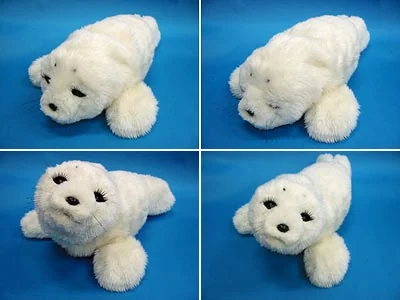

The design
Japan's National Institute of Advanced Industrial Science and Technology, AIST, holds copyright over the product site for Paro, calling it a 'Mental Commitment Robot,' built 'to interact with human beings and to make them feel emotional attachment,' aimed at psychological effects such as relaxation, physiological effects such as improved vital signs, and 'social effects such as instigating communication among inpatients and caregivers.' Paro's own functions page describes the mechanism: styled after a baby harp seal, it carries 'five kinds of sensors: tactile, light, audition, temperature, and posture,' and dates a research video of the biological field study behind the model to 2002. It 'can learn to behave in a way that the user prefers' by reinforcing whichever reaction, stroking rather than hitting, preceded a remembered response, adding a rare caveat: this behavior 'can be perceived as if Paro has feelings,' describing user perception, not a claim of actual feeling.
What the evidence says
AIST itself, with Kimura Clinic and a private brain-function laboratory, ran a study reported in an AIST press release, a translation AIST dates to 16 September 2005: fourteen elderly subjects with cognition disorders had brain waves measured before and after interacting with Paro, and seven of fourteen 'experienced an improvement in brain function.' AIST frames this as evidence 'robot therapy... can be used to prevent cognition disorders,' but the sample is small and the release is AIST's own summary, not an independently reviewed paper.
What it asks of people
Paro's design asks a person to touch, hold and talk to it regularly; the functions page instructs, in its own words, to 'take care of Paro by touching it and talking to it,' and states it 'will be very happy if you take care of it for a long time.' It asks nothing in the way of an account or disclosed data as a networked companion app does, since the interaction described is physical and local.
Privacy and safeguards
AIST's own pages describe no data collection tied to a user's identity; Paro's sensors register touch, sound direction and posture rather than identifiable personal information for transmission elsewhere. The stated caution that Paro's response 'can be perceived as if' it has feelings is a safeguard AIST builds into its own marketing language, distinguishing a design goal of eliciting attachment from a claim about the robot's inner state.
- Does the manufacturer's own language distinguish a design goal of eliciting attachment from a claim that the device has feelings?
- Is a therapeutic claim backed by a specific, cited study, and how large was that study's sample?
- What data, if any, does a companion device with sensors collect about the person interacting with it?
AIST's own pages are notably careful to describe Paro's responsiveness as something a user can perceive as feeling, not as a claim that it does, and the one dated study available here involved fourteen people. Both details matter more than the robot's wide reputation: a reader should weigh a manufacturer's own hedged language and a small sample size before treating a therapeutic reputation as an established finding rather than an evolving research claim.
Sources & reading trail
AIST's own definition of a 'Mental Commitment Robot' and the psychological, physiological and social effects Paro is designed to produce.
Source published: Not established · Retrieved: 16 September 2026
Describes Paro's five sensors, its learned-response mechanism, and the caveat that its behavior 'can be perceived as if' it has feelings.
Source published: Not established · Retrieved: 16 September 2026
AIST's own report of a 14-subject study finding brain-function improvement in 7 of 14 elderly patients with cognition disorders after interacting with Paro.
Source published: 16 September 2005 · Retrieved: 16 September 2026
Product documents, regulator records and studies establish the entry; the design reading is AI Companions editorial analysis. This retrospective draft does not imply the site published on the event date.