The design
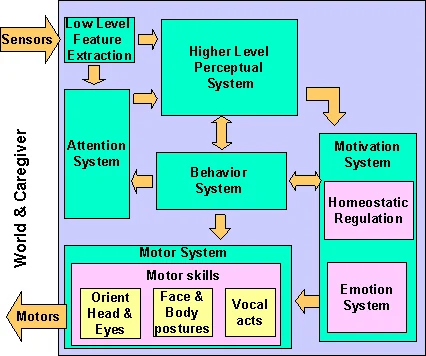
MIT's Humanoid Robotics Group, working with researcher Cynthia Breazeal, published project pages describing Kismet, a robot head built for face-to-face social exchange rather than an industrial task. The overview states the work is 'inspired by infant social development, psychology, ethology, and evolution,' aiming for Kismet to enter 'natural and intuitive social interaction with a human caregiver and to learn from them, reminiscent of parent-infant exchanges.' The companion architecture page lays out six subsystems built around perception, attention, motivation, behavior and motor control, and states Kismet's motivation system models six basic emotions described as 'synthetic analogs of anger, disgust, fear, joy, sorrow, and surprise,' expressed through face motors, gaze, posture and vocal tone. That phrase, synthetic analogs, is the project's own hedge: the system produces emotion-like outputs, not felt states.
What the evidence says
The architecture page is candid that this choice exists to shape the person on the other side of the interaction: 'the expression of emotive responses promotes empathy from the caregiver and plays an important role in regulating social interaction with the human.' MIT's own account frames Kismet's expressiveness as a mechanism for eliciting a caretaker's attentiveness, evaluated by testing whether naive subjects could read and respond to its cues. The lab's own page of open questions, covering self-identity, theory of mind, intentionality and empathy, closes without answers: 'And that's all we have to say for the moment.' That restraint is notable: the team declined, in its own materials, to claim the robot possessed the psychological properties its behavior might suggest.
What it asks of people
Kismet's design asks a human interactant to supply attention, expressive feedback and patience: the system depends on a person reading its face and vocal babble and responding as an adult would to an infant, since its perception system is tuned to cues such as vocal affect rather than language content. It asks for no money, account or disclosed identity, since it was never sold; what it extracts is a caregiving posture the project's own pages compare to a 'caretaker-infant dyad.'
Privacy and safeguards
Because Kismet was a laboratory robot evaluated with volunteers rather than a shipped product, its pages describe no data-handling policy or retention schedule. That is worth naming because later companion products reuse Kismet's central technique, expressive behavior engineered to invite caregiving, while adding what MIT's pages never had to address: persistent data collection about the people who respond.
- Does the product distinguish, anywhere in its own materials, between a modeled emotional response and a felt one?
- What open questions about attachment or intentionality does the maker decline to answer, and does marketing fill that silence instead?
- Who benefits when a system is engineered to elicit a caregiving response: the user, or the company measuring engagement?
Kismet never shipped and collected no user data, so it cannot be blamed for any privacy harm. Its lasting relevance is as a documented origin point: a research team's own account of building a face specifically to make a person feel needed, years before that same technique became a commercial design pattern for AI companion products.
Sources & reading trail
MIT's own description of Kismet's infant-inspired design goal of entering caretaker-infant style social interaction.
Source published: Not established · Retrieved: 16 September 2026
Describes the six-subsystem architecture and states the six modeled emotions are 'synthetic analogs,' expressed to promote caregiver empathy.
Source published: Not established · Retrieved: 16 September 2026
Shows the project's own list of unanswered questions about self-identity, empathy and intentionality, left open rather than claimed.
Source published: Not established · Retrieved: 16 September 2026
Product documents, regulator records and studies establish the entry; the design reading is AI Companions editorial analysis. This retrospective draft does not imply the site published on the event date.