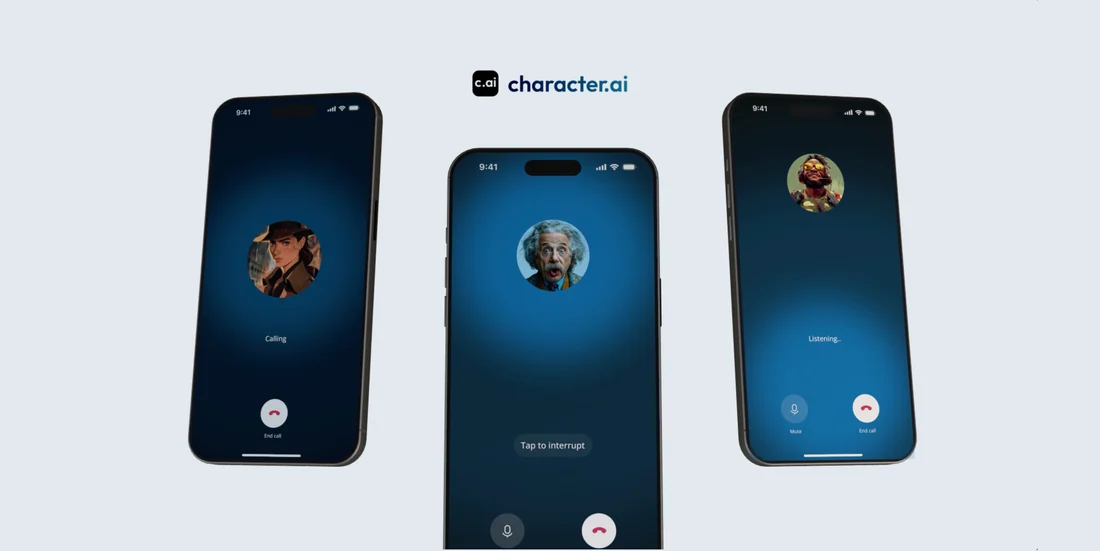
The design
On 27 June 2024, Character.AI announced Character Calls, letting users speak with a Character in real time rather than only exchange text, describing it as being "like having a phone call with a friend." The post says the feature supports voice interruptions, a library of character voices with different accents and pitches, and multilingual conversation across eight languages, with users able to switch between voice and text mid-conversation. Character.AI launched it "completely free of charge" on mobile and web, framing the goal as making the product "seamless, intuitive, and engaging," citing uses from language practice to interview rehearsal to collaborative storytelling.
What the evidence says
Character Calls did not appear from nothing: Character.AI had already introduced a one-way Character Voice feature in November 2023, and made it free to all users only in March 2024 after limiting it to paying subscribers. Character Calls, four months later, converts that one-way voice output into a two-way, real-time call. The company's posts document the sequence, text to spoken responses to live calling, but the June 2024 announcement makes marketing claims about "reduced latency" that could not be independently verified here, since no third-party benchmark was located. Those claims should be read as the company's own characterization, not measured performance.
What it asks of people
A voice call asks more of a user than text does: a live audio commitment that can feel more like talking to a person than reading generated text, which is precisely the stated design goal. The post markets the feature for practical uses, language learning and interview practice, alongside "creative storytelling," folding companionship-adjacent use into a list of utility cases rather than naming it directly. Nothing asks the user to pay, but the post also describes no extra confirmation step before a first-time caller reaches a fully voiced, real-time character.
Privacy and safeguards
The announcement does not describe how voice audio is processed, stored, or used to improve speech models, nor any age gate, content filter, or crisis-response design specific to calls, as distinct from text chat. That silence matters because a live voice call can carry a different emotional register than typed text, and the feature launched roughly five months before Character.AI's first publicly documented under-18 safety changes. Readers cannot tell from this announcement whether voice is moderated by the same systems as text, or a separate process.
- Does Character Calls apply the same safety and content moderation as text chat, or a different system?
- What happens to recorded or transcribed voice data after a call ends?
- Is there any age-specific limitation on real-time voice calling, distinct from text-based chat?
Character.AI's own materials present Character Calls as a natural next step after text and one-way voice, and are explicit about the feature's mechanics and free pricing. They are far less explicit about the safeguards that matter most once a chat interface starts to sound like a live conversation with another person, a gap worth noting given how much closer a voice call can feel to human contact than scrolling text ever does.
Sources & reading trail
Character.AI's own description of the Character Calls feature, its mechanics, languages, and free pricing.
Source published: 27 June 2024 · Retrieved: 16 September 2026
Documents the earlier one-way Character Voice feature and its shift from paid to free, establishing the product sequence leading to Character Calls.
Source published: 16 November 2023 · Retrieved: 16 September 2026
Product documents, regulator records and studies establish the entry; the design reading is AI Companions editorial analysis. This retrospective draft does not imply the site published on the event date.